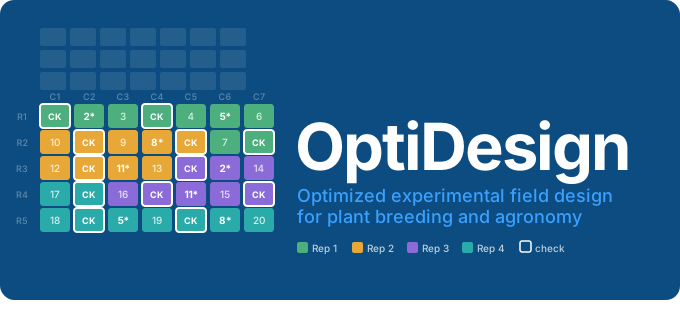
Construct a repeated-check block design with flexible replication
Source:R/prep_famoptg.R
prep_famoptg.Rdprep_famoptg() builds a repeated-check block design for plant breeding
and agronomic experiments. Check treatments are included in every block,
while non-check treatments are allocated according to user-specified
replication levels. Depending on the treatment structure supplied, the
same function generates three design classes:
Augmented repeated-check design: checks repeated in every block, all test entries unreplicated (
p_rep_treatments = NULL).Partially replicated (p-rep) repeated-check design: a mixture of replicated and unreplicated non-check entries.
RCBD-type repeated-check design: all non-check entries given the same replication across blocks.
Design evaluation has been separated from construction. This function
returns the field book, layout matrix, and seed only. To compute A, D, and
CDmean optimality criteria call evaluate_famoptg_efficiency() on the
returned field_book. To search for an optimised design across many
randomisations call optimize_famoptg().
Usage
prep_famoptg(
  check_treatments,
  check_families,
  p_rep_treatments,
  p_rep_reps,
  p_rep_families,
  unreplicated_treatments,
  unreplicated_families,
  n_blocks,
  n_rows,
  n_cols,
  order = "column",
  serpentine = FALSE,
  seed = NULL,
  attempts = 1000,
  warn_and_correct = TRUE,
  fix_rows = TRUE,
  cluster_source = c("Family", "GRM", "A"),
  GRM = NULL,
  A = NULL,
  id_map = NULL,
  cluster_method = c("kmeans", "hclust"),
  cluster_seed = 1,
  cluster_attempts = 25,
  n_pcs_use = Inf,
  check_placement = c("random", "systematic", "optimal"),
  check_opt_attempts = 200,
  use_dispersion = FALSE,
  dispersion_source = c("K", "A", "GRM"),
  dispersion_radius = 1,
  dispersion_iters = 2000,
  dispersion_seed = 1,
  K = NULL,
  line_id_map = NULL,
  verbose = TRUE
)
Arguments
- check_treatments
Character vector of check treatment identifiers. Checks appear in every block. Must not overlap with
p_rep_treatmentsorunreplicated_treatmentsand must not contain duplicates.- check_families
Character vector of the same length as
check_treatments. Family labels for checks, used for adjacency scoring. Always stored in theFamilycolumn;Gclusteris alwaysNAfor check plots.- p_rep_treatments
Character vector of replicated non-check treatment identifiers. Each entry appears in exactly
p_rep_reps[i]distinct blocks. May beNULLorcharacter(0)for augmented designs.- p_rep_reps
Integer vector of the same length as
p_rep_treatments. Number of blocks each p-rep treatment appears in. Must satisfy1 <= p_rep_reps[i] <= n_blocksfor all \(i\).- p_rep_families
Character vector of the same length as
p_rep_treatments. Family labels for p-rep entries.- unreplicated_treatments
Character vector of treatment identifiers that appear exactly once in the full design. May be
NULLorcharacter(0).- unreplicated_families
Character vector of the same length as
unreplicated_treatments. Family labels for unreplicated entries.- n_blocks
Positive integer. Number of experimental blocks.
- n_rows
Positive integer. Number of field rows.
- n_cols
Positive integer. Number of field columns.
- order
Character. Field traversal direction:
"column"fills column by column;"row"fills row by row.- serpentine
Logical. If
TRUE, alternate columns (whenorder = "column") or alternate rows (whenorder = "row") traverse in reverse direction, producing a boustrophedon planting path.- seed
Optional integer. If
NULL, a seed is drawn from1:.Machine$integer.maxand returned asseed_used. Controls all randomised steps: p-rep block assignment, unreplicated entry distribution, within-block shuffling, check placement, and dispersion optimisation.- attempts
Positive integer. Number of within-block shuffle attempts to minimise adjacent same-group pairs. Default 1000.
- warn_and_correct
Logical. If
TRUE, silently adjust field dimensions whenn_rows * n_colsdoes not match the required total plots. IfFALSE, stop with an error.- fix_rows
Logical. Used only when
warn_and_correct = TRUE. IfTRUE, holdn_rowsfixed and expandn_cols; otherwise holdn_colsfixed and expandn_rows.- cluster_source
Character. Grouping source for adjacency scoring:
"Family","GRM", or"A".- GRM
Optional square numeric matrix with rownames and colnames equal to line IDs. Required when
cluster_source = "GRM"ordispersion_source = "GRM".- A
Optional square numeric matrix. Required when
cluster_source = "A"ordispersion_source = "A".- id_map
Optional data frame with columns
TreatmentandLineID. Required when treatment labels do not match relationship matrix rownames.- cluster_method
Character. Clustering algorithm:
"kmeans"or"hclust"(Ward's D2 linkage).- cluster_seed
Integer. Seed for k-means initialisation, run in an isolated RNG scope.
- cluster_attempts
Positive integer. Number of k-means random restarts (
nstart).- n_pcs_use
Positive number or
Inf. Leading PCs retained for matrix-based clustering. Actual number used ismin(n_pcs_use, n_positive_eigenvalues - 1).- check_placement
Character. Check position rule within blocks:
"random"Check positions drawn uniformly.
"systematic"Check positions spaced evenly through the block.
"optimal"Keeps the layout that maximises mean nearest-neighbour distance between check plots in the field across
check_opt_attemptscandidates.
- check_opt_attempts
Positive integer. Number of candidate layouts evaluated when
check_placement = "optimal". Default 200.- use_dispersion
Logical. If
TRUE, apply a post-layout swap-based dispersion optimisation to reduce pairwise relatedness among neighbouring non-check plots.- dispersion_source
Character. Matrix used for dispersion scoring:
"K","A", or"GRM". The corresponding argument must be non-NULL.- dispersion_radius
Positive integer. Chebyshev distance radius defining the neighbourhood for dispersion scoring. Default 1.
- dispersion_iters
Non-negative integer. Number of swap proposals for dispersion optimisation. Default 2000.
- dispersion_seed
Integer. Seed for the dispersion step, run in an isolated RNG scope.
- K
Optional square numeric matrix. Used for dispersion scoring when
dispersion_source = "K".- line_id_map
Optional data frame with columns
TreatmentandLineID. Required when treatment labels do not matchrownames(K)or the dispersion matrix.- verbose
Logical. If
TRUE, prints a one-line summary of field dimensions, block count, and treatment counts.
Value
A named list with three components:
layout_matrixCharacter matrix of dimension
n_rows x n_cols. Used cells contain treatment IDs; unused cells (when field is larger than required) areNA.field_bookData frame with one row per assigned plot. Columns:
Treatment,Family(original user-supplied label),Gcluster(NAwhencluster_source = "Family"or for check plots; otherwise the matrix-derived cluster label prefixed"G"or"A"),Block(integer 1 ton_blocks),Plot(sequential integer),Row,Column.seed_usedInteger. The random seed used.
Details
Design structure and allocation rules
Let:
\(c\) = number of check treatments
\(b\) =
n_blocks\(v_p\) = number of p-rep treatments with replication counts \(r_1, r_2, \ldots, r_{v_p}\)
\(v_u\) = number of unreplicated treatments
Total plots required: $$\text{total} = b \times c + \sum_{i=1}^{v_p} r_i + v_u$$
Allocation rules enforced by construction:
- Checks
Appear in every block. Each check contributes \(b\) plots total.
- P-rep treatments
Each treatment \(i\) appears in exactly \(r_i\) blocks, always in distinct blocks - never twice in the same block. This is the core p-rep constraint.
- Unreplicated treatments
Appear exactly once in the full design, distributed as evenly as possible across blocks.
Three design classes
Augmented repeated-check design - obtained when p_rep_treatments
is empty and all non-check entries are supplied via
unreplicated_treatments. Checks are the only repeated treatments.
P-rep repeated-check design - obtained when some non-check entries
in p_rep_treatments have p_rep_reps > 1 and others are unreplicated.
The most general use case: a mixture of replicated candidate entries and
single-plot entries alongside repeated checks.
RCBD-type repeated-check design - obtained when all non-check
treatments are supplied via p_rep_treatments with a common replication
count greater than 1. If that count equals n_blocks, every non-check
treatment appears once in every block - the closest repeated-check
analogue of a classical RCBD.
Field dimension handling
If the supplied n_rows x n_cols field does not exactly match the
required total plots, the function either stops (when
warn_and_correct = FALSE) or silently adjusts one dimension
(warn_and_correct = TRUE). When adjusting, fix_rows = TRUE holds
n_rows fixed and expands n_cols; fix_rows = FALSE does the reverse.
Surplus cells remain NA in the layout matrix.
Within-block arrangement
Treatments are shuffled within each block over attempts random
permutations to minimise the count of adjacent same-group treatment pairs
in the 1D block ordering. The group label used for adjacency scoring is
determined by cluster_source (see below). Checks are inserted at
positions controlled by check_placement:
"random"Check positions drawn uniformly.
"systematic"Check positions spaced evenly through the block.
"optimal"Runs
check_opt_attemptscandidate layouts and keeps the one maximising the mean nearest-neighbour distance between check plots in the field - encouraging spatial spread of checks.
Grouping and adjacency scoring
cluster_source determines the group label used to penalise adjacent
same-group treatments within blocks:
"Family"Uses
p_rep_familiesandunreplicated_familiesdirectly.Gclustercolumn in the field book isNAfor all plots."GRM"Derives clusters from PCA of the genomic relationship matrix
GRM. Number of clusters =length(unique(p_rep_families)). Cluster labels are prefixed"G"."A"Derives clusters from PCA of the pedigree relationship matrix
A. Cluster labels are prefixed"A".
Check treatments always use check_families for grouping and always
have Gcluster = NA.
Dispersion optimisation
When use_dispersion = TRUE, a local swap search runs after layout
construction. At each of dispersion_iters iterations two non-check plots
are selected at random; the swap is accepted if it reduces the total
neighbourhood relatedness score - the sum of relationship matrix values
between non-check neighbour pairs within Chebyshev distance
dispersion_radius. The matrix used is selected by dispersion_source.
See also
evaluate_famoptg_efficiency() to compute A, D, and CDmean
optimality criteria on the returned field_book.
optimize_famoptg() to search for a criterion-optimal design using
Random Restart.
Examples
## Augmented repeated-check design: checks repeated, entries unreplicated
design_aug <- prep_famoptg(
  check_treatments        = c("CHK1", "CHK2"),
  check_families          = c("CHECK", "CHECK"),
  p_rep_treatments        = character(0),
  p_rep_reps              = integer(0),
  p_rep_families          = character(0),
  unreplicated_treatments = paste0("E", 1:80),
  unreplicated_families   = rep(paste0("F", 1:4), 20),
  n_blocks = 5, n_rows = 10, n_cols = 20
)
#> Warning: Field size (10 x 20 = 200) does not match required plots (90). Adjusting dimensions.
#> Field = 10 x 9 | total plots = 90 | checks/block = 2 | p-rep entries = 0 | unreplicated = 80 | n_blocks = 5
dim(design_aug$layout_matrix)
#> [1] 10  9
head(design_aug$field_book)
#>   Treatment Family Gcluster Block Plot Row Column
#> 1       E78     F2     <NA>     1    1   1      1
#> 2       E55     F3     <NA>     1    2   2      1
#> 3       E60     F4     <NA>     1    3   3      1
#> 4       E69     F1     <NA>     1    4   4      1
#> 5      CHK1  CHECK     <NA>     1    5   5      1
#> 6       E12     F4     <NA>     1    6   6      1

## P-rep design: some entries replicated twice, others once
design_prep <- prep_famoptg(
  check_treatments        = c("CHK1", "CHK2"),
  check_families          = c("CHECK", "CHECK"),
  p_rep_treatments        = paste0("P", 1:20),
  p_rep_reps              = rep(2L, 20),
  p_rep_families          = rep(paste0("F", 1:4), 5),
  unreplicated_treatments = paste0("U", 1:60),
  unreplicated_families   = rep(paste0("F", 1:4), 15),
  n_blocks = 5, n_rows = 15, n_cols = 20,
  check_placement = "systematic"
)
#> Warning: Field size (15 x 20 = 300) does not match required plots (110). Adjusting dimensions.
#> Field = 15 x 8 | total plots = 120 | checks/block = 2 | p-rep entries = 20 | unreplicated = 60 | n_blocks = 5
table(design_prep$field_book$Block)
#>
#>  1  2  3  4  5
#> 20 25 19 26 20

## Evaluate separately
eff <- evaluate_famoptg_efficiency(
  field_book         = design_prep$field_book,
  n_rows = 15, n_cols = 20,
  check_treatments   = c("CHK1", "CHK2"),
  treatment_effect   = "fixed",
  residual_structure = "AR1xAR1",
  rho_row = 0.10, rho_col = 0.10
)
eff$A_criterion
#> [1] 3.067247